
VULCAN

STAR SYSTEM: 40 Eridani
ALTERNATE NAME: Ni'Var
FORMAL NAME: Vulcan Confederation
CAPITOL: Kir Ahl (Kir)
CO-PLANETS: T'Khut and Delta Vega
PREDOMINATE SPECIES

Vulcan
Vulcan is the primary planet of the 40 Eridani star system and home planet of the Vulcan race. The planet was once a lush world teeming with life, however forty thousand years ago the passage of a rouge star caused a shift in the planet's orbit and locked the world into a new rotation (along with its sister world T'Kuht) causing most lifeforms to become extinct and the planet to become a desert.

Present day Vulcan consists of vast desert landscapes, jagged mountain ranges, and two large salt oceans
The majority of Vulcan is a vast desert interspersed among several mountain ranges, deep chasms, and canyons. The planet hosts two large oceans and, through advances in hydroponic engineering and desalination, these are the primary sources of water for the entire planet. Most lifeforms on Vulcan are adapted to survive in extreme temperatures with little food or water for days and, even with such adverse conditions, Vulcan hosts an abundance of desert plant and animal life.
The planet Vulcan is also known for electrical sandstorms which sweep across the world's deserts and are able to disrupt most modern sensor technology and communications equipment. In addition, a large connecting cave network encompasses subterranean areas beneath the Vulcan mountain ranges for hundreds of kilometers.

The Le-matya and Sehlat are the two most common predators on Vulcan
KIR AHL

MAJOR ATTRACTIONS AND LANDMARKS
Kir Ahl is the largest city on Vulcan, the capitol of the planetary government, as well as the seat of the local Vulcan province of Kir. The capitol city is a sprawling metropolis of buildings and structures, some over two hundred stories in height. The Vulcan High Command maintains its headquarters in Kir Ahl as do all of the major Vulcan ministries.
VULCAN'S FORGE

Vulcan's Forge is a large area of desert terrain, containing interconnecting caves and canyons, which is generally considered one of the most inhospitable locations on Vulcan. The Forge holds significant religious and spiritual meaning to the Vulcan people, as it was here in the fourth century AD in which the Vulcan philosopher Surak developed the philosophy of Total Logic as well as Infinite Diversity in Infinite Combinations (known as IDIC)
VULCAN SCIENCE ACADEMY

The Vulcan Science Academy is considered one of the most prestigious institutes of higher learning on Vulcan, attendance at which is usually reserved for only the best minds and intellects of the Vulcan people. The science academy has produced such famous Vulcan scholars as Sitar and T'Seratak, as well as several Vulcans who have risen to prominence in both the academic and government service.
FIRE PLAINS
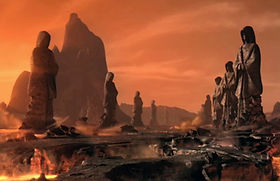
The Fire Plains of Vulcan, located adjacent to Vulcan's Forge, are considered an important location for disciples of Kolinahr, the traditional purging of all emotion. Kolinahr adepts spend years mediating and studying within the fire plains in order to obtain the symbol of Total Logic, considered the highest honor which may be bestowed by the Kolinahr Masters.
MOUNT SELEYA
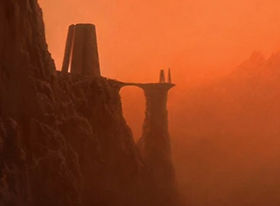
Mount Seleya is considered one of the most sacred places on all of Vulcan, being the traditional location from which Surak is stated to have written his final scriptures on achieving logic over emotion. The mountain is also where Surak died (a result of radiation poisoning from Vulcan's atomic wars) and where the concept of the katra was developed, considered a Vulcan's immortal soul.
VULCAN HISTORY
Records of Vulcan pre-history are sporadic and fragmentary, with some theories suggesting that the Vulcan race may have originally been seeded on the world by an extra-terrestrial source, prior to the planet becoming a desert. By ten thousand BC, the Vulcan race had adapted to life on the desert world and evolved enhanced strength, ears capable of cupping sound in the thin desert air, as well as an inner eyelid to protect from the harsh rays of Vulcan's sun. At around this time, Vulcans had also begun to develop mental powers and psionic capabilities.
By 3000BC, Vulcan had developed a polytheistic religion and the first of the "mental wars" took place, using psionic powers and various psi-weaponary such as the Stone of Gol. Vulcans during this period were described as extremely warlike and aggressive and were said to have "almost killed themselves off with their own passions".
By 1400BC, Vulcan had begun its Middle Ages and this period is often known as the "Time of the Beginning". Manned spaceflight began three hundred years later with warp drive discovered in 900BC.

The Stone of Gol was a psionic amplifier designed to channel negative emotions as a lethal energy burst

The Eridani star system contains several asteroid belts which were extensively mined during Vulcan's early space age, circa 1100BC.
By 400AD, Vulcan was a highly advanced technical society, however the planet itself was divided between several warring factions and nation states. The planet fell into near endless warfare, including several attacks with atomic weapons. It was during this period that a Vulcan philosopher named Surak called for an end to the wars through a new philosophy of total logic.
Following an embracement of Surak's teachings, Vulcan underwent a one-thousand-year recovery period. Not all Vulcans accepted Surak, however, and several of the more violent factions, including "those who march under the Raptor's wings", departed the planet to seek new worlds in interstellar space.

The Time of Awakening, circa 400AD, was marked by atomic wars on Vulcan
In 1535AD, the Vulcan High Command was formed which has remained the planetary government of Vulcan ever since. Over the next three hundred years, Vulcan survey and scientific craft explored a large portion of the Beta Quadrant of the Milky Way, culminating in the publication of the Vulcan star chart database, considered one of the most accurate stellar mapping collections of all time.

The T'plana Hath Survey Craft was one of several ships to study Earth in the 21st century, making first contact in 2063.
Vulcan survey missions to Earth began in the mid 19th century and peaked in the 1950s and 60s as Earth began to embark in space exploration. However, due to the deteriorating political condition on Earth, and the growing risk of nuclear war, survey missions to Earth were formally ended in 2027.
Vulcans would not return to Earth for over thirty-five years, following the successful warp drive launch of the Pheonix by Zephram Cochrane in 2063. Initially, most of Earth's governments were suspicious of the Vulcans and it would not be until the early 2100s, after several diplomatic treaties had been signed with the various Earth nations, in which Vulcans were seen as friends of humanity.
In 2114, the Vulcan government signed the highly significant "Treaty for Scientific Permission", in which Vulcan offered to provide technical and scientific information concerning warp flight in exchange for Earth severely curtailing its warp program and proceeding only with Vulcan approval.
The treaty was extremely unpopular, in particular with UESPA which was now required to have its spaceship commanders approved by a Vulcan liaison officer. With the founding of the United Earth government in 2134, several revisions were made to the treaty, however Vulcan in general was still permitted to control the pace of Earth's warp program.